What is a warrant?
A warrant is an official document from a court or government agency. It lets law enforcement do something, like search inside a private space for something or arrest someone.
Translations: Arabic | Chinese – Simplified | Chinese – Traditional | Español | Haitian Creole
-
Judicial Warrant
A judicial warrant is issued by a court and signed by a judge (but not an immigration judge) or a magistrate. A magistrate is a court official who has some of the same powers as a judge (but not all of them). A judicial warrant lets law enforcement arrest somebody, take something, or search for something or someone. To get this kind of warrant, law enforcement has to show the judge that they have “probable cause” (or a reasonable belief) that a crime happened.
-
Administrative or Immigration Warrant
An administrative or immigration warrant is a document issued by a federal agency, like Immigration and Customs Enforcement (ICE) or Customs and Border Protection (CBP). These warrants are signed by an immigration officer or another federal officer. An administrative warrant does not allow officers to enter private places like a house, but it can allow them to arrest someone in public or in private (if allowed to enter).
-
Blackie’s Warrant
A Blackie’s warrant is a civil search warrant that a judge or magistrate signs. It is named after a court case called Blackie’s House of Beef v. Castillo. In that case, the court said immigration officers can use civil warrants from judges to search worksites.
A Blackie’s warrant is different from a criminal warrant because law enforcement does not have to show “probable cause” that a crime happened to get a Blackie’s warrant. Instead, they have to show “probable cause” (or a reasonable belief) that someone at a particular worksite is not in the United States legally. The warrant still has to be specific about the place that they want to search.
How do I know what kind of warrant a document is?
This chart will help you figure out what kind of warrant a document is:
| Judicial Warrant | Administrative Warrant | Blackie’s Warrant | |
|---|---|---|---|
| Who issued the document? | Court | Agency (such as DHS or ICE) | Court |
| Who signed the document? | Judge/magistrate | Officer | Judge/magistrate |
| Is there an address listed that they want to search? | Yes | No | Yes |
| Is the word “alien” in the title? | No | Yes (“Warrant for Alien Arrest”) | No |
| Does the form start with the letter “I” (for example the Form I-200 or I-205)? | No | Yes (a form beginning with the letter “I” may indicate it’s an immigration form) | No |
-
When do immigration officers not need a warrant to arrest someone?
The law says immigration can only arrest someone without a warrant in very few situations. Before arresting someone without a warrant, federal law requires immigration to be able to prove that:
- The person is in the United States illegally, AND
- That person is likely to escape before officers can get a warrant.
Under the law, immigration can search vehicles without a warrant if they are near (usually within 100 miles) an international border. No matter where immigration stops someone, the rule above applies: immigration officers cannot arrest someone without a warrant unless they have probable cause that they are in the U.S. without permission and that they are likely to flee before a warrant can be written.
-
How does immigration use these warrants?
ICE usually are the immigration officers you see in the United States, but you might also see CBP inside the United States, even far from the border. You might not know who officers are because they do not always tell the public who they are, so we will just call them all “immigration.”
No Warrants
- Immigration officers often arrest people even when they don’t have a warrant. Sometimes, people challenge those arrests in court.
- In criminal court, the prosecutor usually can’t use evidence that was collected illegally. This rule is called the “exclusionary rule.” But in immigration court, this rule doesn’t usually apply. This means ICE can still try to deport someone even if their arrest was illegal and warrantless. There are a few exceptions when the officer’s actions were part of a bigger pattern of abuse.
Judicial Warrants
- Immigration uses these warrants to go into homes or businesses when they think a crime has happened. The crime could even be something related to immigration, like entering the United States without permission, or coming back to the United States after being deported.
- Judicial warrants let officers go into private areas, like parts of a home or business that aren’t open to the public. They can only search the places listed on the warrant, and only take the items listed on the warrant. Immigration almost never uses judicial warrants. If they don’t have one, they need permission (also called consent) to enter a home, business, or any other private place. Once you give permission, it is very difficult to limit what officers do inside a private space.
Administrative Warrants
- Immigration usually uses these warrants to arrest a person in public. Sometimes officers try to use administrative warrants to get people to let them into their homes or businesses, but these warrants don’t allow that. Without permission or a judicial warrant, officers cannot go inside a home or other private space.
- If immigration officers only have an administrative warrant, you do not have to let them in to your private space. But if you know that a person whose name is on the warrant is inside and you deny that they are there, and you refuse to let the officers in, you could be charged with a crime called “concealment.”
Blackie’s Warrants
- Immigration has tried to use these civil administrative inspection warrants to raid workplaces. Officers can’t get these warrants without probable cause (or a reasonable belief), and they can’t use these warrants as an excuse to search for something other than what is listed. Immigration says Blackie’s warrants let them go in to look for immigration violations, but this is probably against the law. These warrants likely violate the 4th Amendment of the U.S. Constitution, and they can’t be used to search for people or crimes.
-
What are your rights when immigration shows up with a warrant?
You always have the right to remain silent if immigration officers question or arrest you. Always ask to see their ID and ask what they want. Stay calm. Don’t run, resist, or fight. Never lie or give fake papers.
Here are some tips on what to do if you see immigration in different places.
At Home
- You do not have to open the door. Even opening it a little can count as giving permission (consent) for officers to come in.
- Say loudly and clearly, “I do not consent to you entering my house.”
- If they want to come in, ask to see a warrant. They can show it through a window or peephole, or slide it under the door. If it’s not a judicial warrant, they can’t enter without your permission.
- If they have a warrant that allows them to enter, use your right to remain silent.
- If they force their way in, don’t fight or resist.
At a Traffic Stop or on the Street
- You may not know the officers are immigration at first, because they might not tell you until after they arrest you. Ask who they are and ask for identification.
- Don’t roll down your window unless they tell you to. If you do, only roll it down a little, so they can’t reach inside. Be aware they might break the window or force the door open.
- If they ask for ID, only show your driver’s license or other U.S. government-issued ID. Don’t show foreign papers.
- Immigration can’t search your car or belongings without a judicial warrant or your consent. They can pat someone down over clothes for safety or if they’re arresting someone.
At a Business (Employer)
- You do not have to agree to a search.
- Immigration can go into public areas like parking lots or lobbies without your permission, but they can’t enter private areas. Even if they’re inside, they can’t detain, arrest, or question anyone without a warrant.
- Mark private areas clearly with signs like “Private,” keep doors locked, and have a rule that visitors can’t enter those areas without permission.
- If officers show a warrant, make sure it’s a judicial warrant that lists what areas and things they can search. Anything not listed can’t be searched or taken.
- If officers show an administrative warrant with an employee’s name on it, you don’t have to say if that person is there (unless you are asked) or take them to the employee.
- For more information on what to do if immigration comes to your workplace, see here.
What do warrants look like?
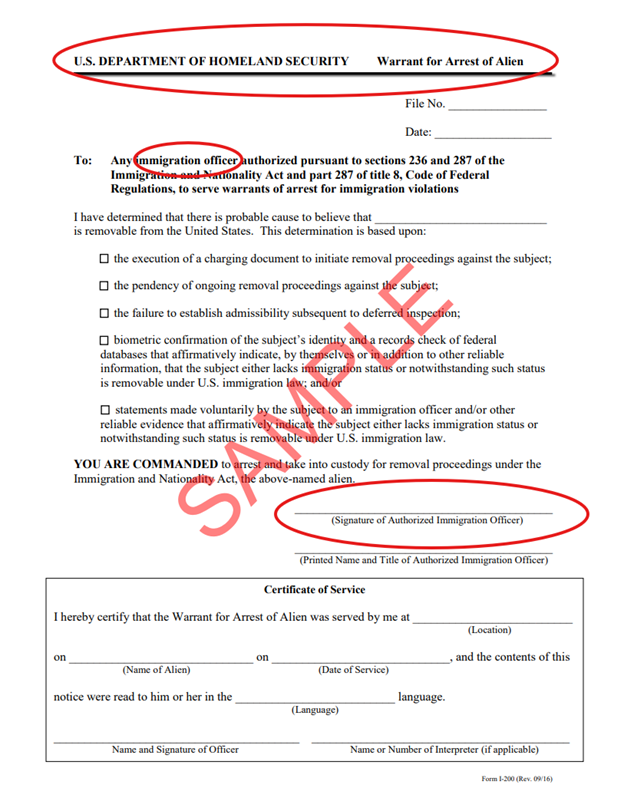
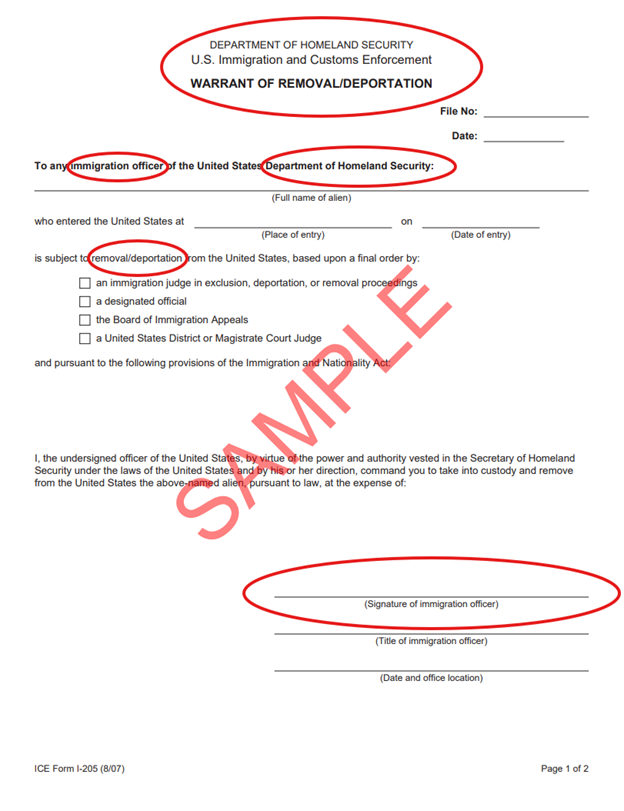
Administrative Immigration Warrants
The circled parts show these are immigration warrants, not judicial warrants. The words “immigration officer,” “alien,” and “Department of Homeland Security” help determine this.
Judicial Warrants
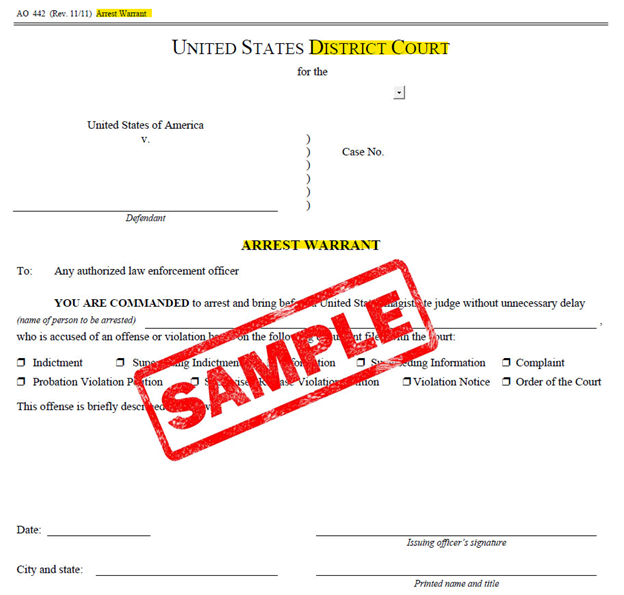
The highlighted portions show that these are judicial warrants. The cues are that: they include “search and seizure” or “arrest; a court issued the warrants; a non-immigration judge signed them; and they specify the person/property/area to be searched.
Warrant for a search only

Conozca sus derechos: Órdenes judiciales
Published Dec 22, 2025 Lea nuestro recurso "Conozca sus derechos" para comprender los tres tipos de órdenes judiciales que debe conocer.
Know Your Rights: CBP Home
Published Feb 12, 2026 President Trump’s Project Homecoming pressures immigrants to “self-deport” using the CBP Home mobile application. This resource provides more information.
Know Your Rights: Five Things Parents Detained by ICE Should Know
Published Nov 20, 2025 Read our latest KYR, created in partnership with CLASP, on things parents should know if they are ever detained by ICE.
Know Your Rights: What to Do if You Are Arrested or Detained by Immigration
Published Apr 9, 2025 This Know Your Rights resource provides general information on what to do if you are stopped, arrested, or detained by immigration or other law enforcement.